
Unlocking
Subsurface PotentialTM
The IDEON REVEALTM solution is based on a fully integrated technology stack, delivering actionable subsurface insights to drive success in operational and safety performance.
Subsurface Intelligence Platform™
Our suite of proprietary data-generation hardware, software, AI-powered services, and multi-physics fusion algorithms unlock the exponential power of integrated spatial data.

A dynamic, high-resolution data model of the subsurface, ensuring that insights and decision support are perspicuous.
Our technology transforms unique, disparate data sets into powerful visualizations, meaningfully enhanced by a user face enabling collaboration and traceability, and focused AI augmentation to navigate the complexities of geoscience data.
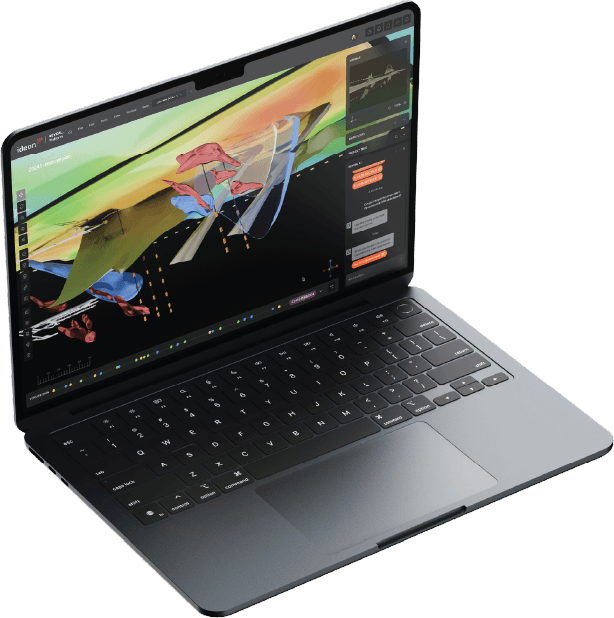
Applying deep numerical programming expertise, enhanced by academic collaborations with Stanford University’s Mineral-X program, the University of British Columbia’s Mineral Deposit Research Unit, and Simon Fraser University.
Focused use of artificial intelligence allows high precision targeting from muon tomography, generative data inversion models driven by a comprehensive geological framework, and 3D prospectivity mapping.
Our multi-physics data inversion algorithms fuse proprietary, high-resolution muon data with existing lower-resolution geophysical data. Combining measurements from magnetic, gravitational, seismic, and muon tomographic data streams yields integrated and refined Earth models for subsurface clarity.
We deliver quantified measures of uncertainty throughout the dynamic 3D and 4D models, leading to more confident subsurface interpretation.

Muon Tomography

Drill core

Gravity

Magnetic

Geochemistry

Resistivity
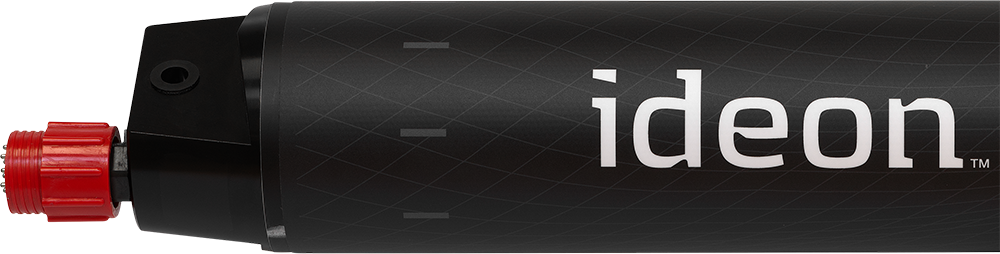
Our proprietary muon detectors enable this world-leading subsurface imaging technique, delivering superior resolution and depth capabilities compared to other geophysical methods. The in-mine panel detector is designed for active underground mining environments, and the borehole detector is deployed directly in in drill holes from surface.

FEATURED TECHNOLOGY
Muon Tomography
Our foundational imaging technology – muon tomography – is the only straight-line subsurface imaging technology available today, delivering the highest available resolution along with precise anomaly location information.
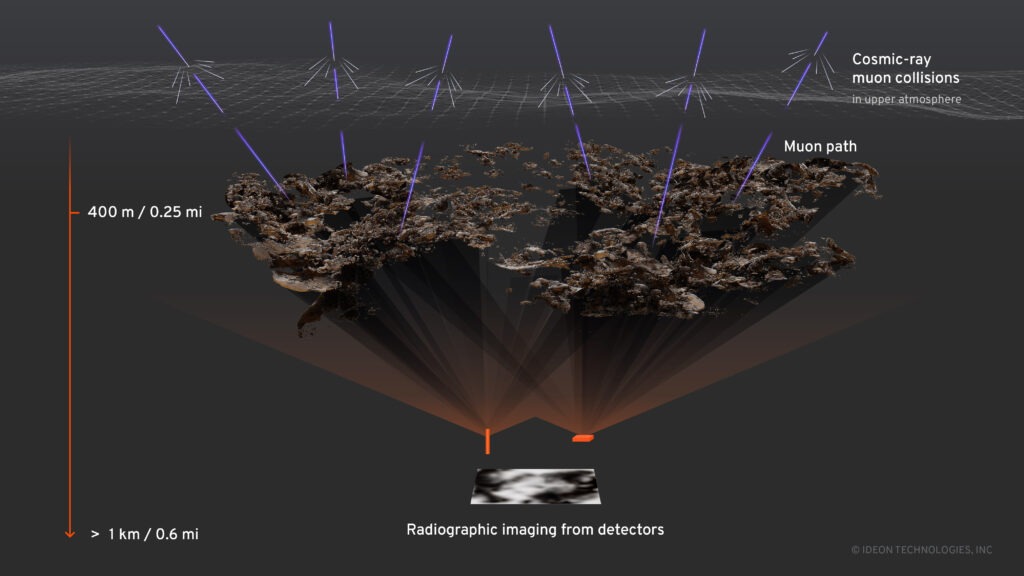
- Harnesses the cosmic-ray muon – a passive and naturally-occurring subatomic particle created from supernova explosions.
- Ability to image in noisy or conductive environments in the most challenging operational environments.
- Subsurface insights at depths unreachable with traditional geophysics.
- Continuous data capture, improving imaging results over the course of a survey.
Muon Tomography
FAQs
A muon — pronounced myoo-aan named for the Greek letter mu (μ), which is used to represent it — is a naturally occurring sub-atomic particle produced by cosmic rays striking the Earth’s atmosphere. These rays are not harmful to us or any other life on the surface of Earth. Muons pass through the surface of the Earth on average about once per minute for every square centimetre. To make it more personal, a muon passes through your head once every second!
Muons travel in straight lines and lose energy progressively as they pass through the Earth’s surface. As they encounter higher-density material, muons lose energy at an accelerated rate, which reduces their intensity. The intensity, and hence the density of the materials encountered, can be measured.
Muon tomography maps the intensity of cosmic-ray muons underground, measuring the physical properties in a targeted search area, much like medical tomography images the interior of the body using x-rays. The resulting images are combined to produce a 3D model of any anomalies present.
Muons can penetrate multiple kilometres into the Earth. The trade-off becomes less about physics and more about deployment economics, imaging objectives, detector access, and decision value.
As muon flux decreases with depth, system design must account for trade-offs in:
- Imaging time
- Resolution
- Detector placement and imaging volume
- Imaging target size
- Density contrast
- Access geometry
Muon tomography can and has been used down to ~1.5 km, especially for large, high-contrast targets such as caves, voids, dense bodies, and major structural or geotechnical features where detector deployment access is available.
Muon tomography directly measures how geological features on your site interact with fundamental physics that are consistent everywhere on Earth. No matter where you are, cosmic-ray muons continuously arrive and interact with matter in a consistent, predictable, measurable way.
Muons lose energy progressively as they pass through material, and the rate of that loss depends primarily on bulk density. If something attenuates muons more strongly at your site, that simply reflects higher density, which we measure directly as a reduction in muon intensity.
Muon tomography doesn’t assume how your unique geology behaves – it measures it. By observing the directional intensity of muons and modelling how they are attenuated along each path, we use it to recover a 3D density model of your site.
Muon imaging is passive and depends on naturally occurring cosmic-ray muons, so acquisition time matters. Optimal data acquisition time can range from hours near surface, to weeks in block caving environments (imaging from underground drives), to months in exploration (imaging from deep drillholes).
Required imaging time is determined by a combination of:
- Size and depth of the imaging target
- Detector geometry
- Required resolution
- Rock density and contract to host rock
- Detector array size
Increasing the detector array can materially reduce imaging time. Put simply: more detector area captures more muons, accelerating statistical confidence.
Survey configuration is tailored to the specific parameters of the client site and geological challenge. The factors we consider when forward-modelling a deployment include: size, depth, and geometric orientation of the target; the density contrast between the target and the host rock; the resolution required for optimal decision-making; the proximity of the target to our sensors; and the overall topography of the area. To deliver an accurate 3D model, we place multiple detectors at different depths and positions to provide different perspectives of the target.
Muon tomography helps companies be more targeted and drill more intelligently, helping operators:
- Prioritize drill targets and identify anomalies
- Test competing geological interpretations
- Delineate the orebody
- Improve confidence in resource and geotechnical models
The goal is not simply fewer metres drilled. The goal is better decisions per metre drilled — and fewer high-cost surprises between holes.
Muon tomography measures density, not chemistry. While it does not directly detect grades of copper, gold, nickel, or uranium, what it detects are density contrasts: dense zones, low-density zones, voids, broken ground, lithological boundaries, alteration, structural controls, cave backs, saturation changes, mass movement, and material flow.
Where density correlates with mineralization or grade (as it does in many mineral systems) muon tomography can act as a powerful proxy and help identify areas of higher potential. Where it does not, Ideon generates a subsurface density wireframe that can help unify, constrain, and fuse other datasets into a more reliable understanding of mineralization.
Muon tomography is the only straight-line subsurface imaging technology available today, delivering the highest available resolution along with precise anomaly location information. It uses a passive and free energy source (cosmic-ray particles from space), offers the ability to image in noisy or conductive environments (where other techniques do not), provides insights from depths that other techniques cannot, and captures data continuously – improving imaging results over the course of a survey. This unique data source, combined with Ideon’s proprietary processing algorithms and multi-data-set analysis, gives our clients a comprehensive set of subsurface intelligence that they’ve never had access to before.

